School Mental Health Screenings: Research Suggests Potential for More Harm Than Good
08/02/2026 / By Morgan S. Verity

School districts across the United States have expanded universal mental health screening programs in recent years, according to education officials and state records. But a review cited by Children’s Health Defense (CHD) reports that school-based routine or universal mental health screening “often functions as an entry point into a therapeutic culture that pathologizes normal childhood distress, erodes resilience and funnels children toward psychiatric labels, therapy, and medication,” according to Gretchen Watson, Ph.D., a clinical psychologist and researcher [7].
The report’s authors and researchers stated that universal screening is being implemented despite insufficient data on its effects. In 2025, Illinois mandated that all schools test every student’s mental health, according to reports [1].
Critics said the mandate allows school counselors to deem any student mentally imbalanced without science or medical background [1]. School districts in other states have adopted similar programs, according to state records and education officials.
Research Evidence Points to Potential Harms
Studies cited in the report indicated that screening can lead to false positives, labeling of children and unnecessary referrals to mental health services. According to the report, there is little evidence that these programs reduce suicide risk or improve long-term mental health outcomes, and some data suggest iatrogenic effects, meaning the screening itself may cause harm rather than benefit.
The report stated that harms include increased anxiety, stigma and distress among students who are identified as at-risk [7]. Research on labeling in educational and social service settings has documented that “labeling, stigma, categorization, and contempt of the poor necessarily follow this deficit philosophy,” according to Valora Washington in “Black children and American institutions” [6]. Researchers said this dynamic can follow a child through their school career and influence how teachers and peers perceive them.
A 2005 lawsuit against an Indiana school and mental health agency highlighted concerns over TeenScreen, a school-based mental health screening program, according to a report by Mercola.com [3]. The report also noted that 2014 data showed an alarming number of babies under one year old being prescribed potent psychiatric drugs, including anti-anxiety medications, antidepressants, ADHD treatments and antipsychotics, raising questions about the validity of diagnosing serious mental health issues in young children [3].
Reasons Behind Widespread Adoption
Policymakers and education officials said screenings help schools identify students who need support early, particularly after rises in youth mental health emergencies. More than one in three high school students last year experienced poor mental health and 44% reported they felt sad or hopeless during the pandemic, according to a report by the Centers for Disease Control and Prevention [9].
Federal and state funding has encouraged districts to adopt universal screening, according to government announcements. In January 2016, the U.S. Preventive Services Task Force issued final recommendations suggesting that all Americans undergo mental health screenings, according to a report [4].
Screening techniques have long been a standard tool in public health practice, according to David J. Anspaugh in “Teaching today’s health” [5]. The expansion has also received private funding: billionaires Melinda French Gates and MacKenzie Scott invested a total of $23 million in the School-Based Health Alliance, the leading national nonprofit that promotes the expansion of school-based health centers, according to CHD [8].
Supporters of the programs cited statistics on adolescent depression and anxiety as justification for early detection efforts, officials said. Screening programs, they said, can connect students to counseling and other services before problems escalate.
Critics Cite Privacy, Consent and Overdiagnosis Concerns
Critics argued that school-based screenings often bypass parental consent and may violate student privacy, according to advocacy groups. The Killingly, Connecticut, school board faced an inquiry and lawsuit after rejecting a government-funded school-based mental health center run by an outside contractor that doesn’t require parental consent to treat teens, according to CHD [10]. Concerns about consent extend beyond screening programs: critics of school-based health centers have said the centers could allow children to get vaccines and mental health counseling without parental consent, according to CHD [11].
Rep. Ron Paul (R-KY) introduced the Parental Consent Act in 2009 to protect families from mandatory mental health screening, which he described as “a thinly veiled attempt by Big Pharma to drug expectant mothers and new moms with dangerous psychiatric drugs” [2]. The bill would have forbidden federal funds from being used for any universal or mandatory mental health screening, according to the text of his speech [2].
Some health professionals expressed concern that screening tools are not diagnostic and can label children without full clinical assessment. Families have reported that children were placed in psychiatric treatment following screenings that produced questionable results, according to testimony cited in the report.
Outlook: Calls for More Evidence Before Further Expansion
The report urged school districts to pause or reconsider universal screening until more robust research is available, according to its authors [7]. The lack of evidence for long-term benefit, combined with documented risks, led researchers to recommend a more cautious approach.
Officials and researchers recommended alternative approaches, such as improving access to voluntary counseling and mental health education. In the meantime, some districts have chosen to modify or delay screening programs pending further review, as reported by local news outlets. Researchers said the priority should be supporting children through evidence-based programs that do not carry the risks associated with universal labeling.
References
- S.D. Wells. “The State of Illinois Has Gone FULL ORWELLIAN and Mandated All Schools to Test Every Student’s ‘MENTAL HEALTH’ Based on FAKE SCIENCE”. NaturalNews.com. August 17, 2025.
- NaturalNews.com. “Speech of Ron Paul Introducing the Parental Consent Act”. NaturalNews.com. May 2, 2009.
- Mercola.com. “Taking One of These Meds Your Life Could Be”. Mercola.com. October 18, 2023.
- NaturalNews.com. “Forced Mental Health Screenings: A Push For Communism”. NaturalNews.com. February 24, 2016.
- David J. Anspaugh. “Teaching today’s health”.
- Valora Washington. “Black children and American institutions: an ecological review and resource guide”.
- Children’s Health Defense. “Schools Are Pushing Mental Health Screening. Research Shows It Does More Harm Than Good”. Children’s Health Defense. July 31, 2026.
- Children’s Health Defense. “Billionaires Melinda French Gates and MacKenzie Scott Invest $23 Million to Promote School-Based Health Centers”. Children’s Health Defense.
- Children’s Health Defense. “44% of Teens Felt ‘Sad’ or ‘Hopeless’ During Last Year, CDC Says”. Children’s Health Defense.
- Children’s Health Defense. “Connecticut School Board Faces Lawsuit for Rejecting School-Based Mental Health Clinic That Wanted to Treat Teens Without Parents’ Consent”. Children’s Health Defense.
- Children’s Health Defense. “‘So Many Pitfalls’: Feds Push School-Based Health Centers as Critics Sound Alarm Over Lack of Parental Consent”. Children’s Health Defense.
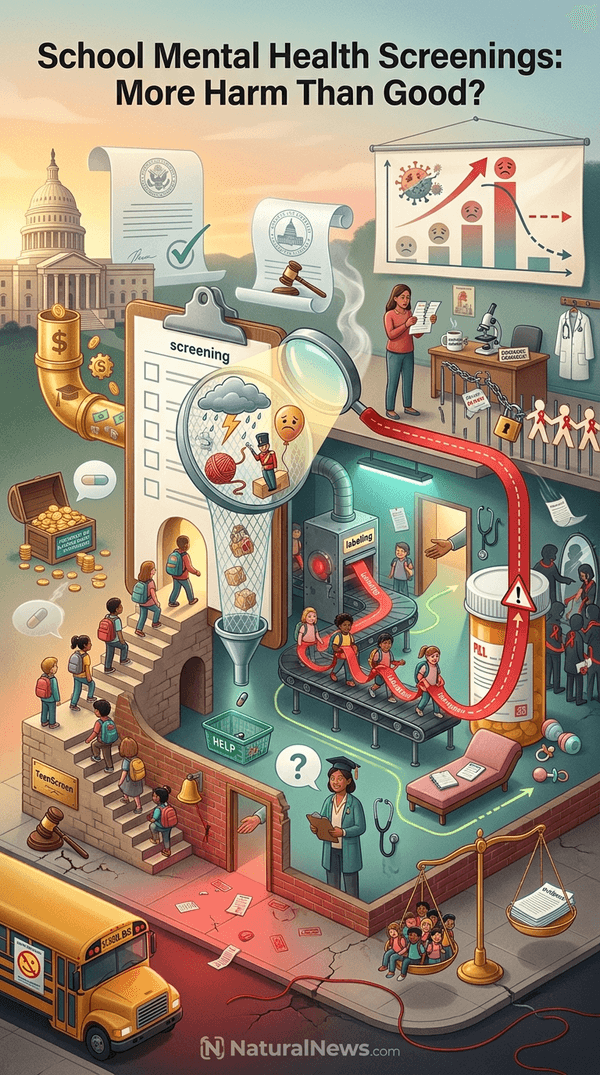
Explainer Infographic
Submit a correction >>
Tagged Under:
brain damaged, brain function, brain health, campus insanity, children's health, cognitive function, education, education system, growth, mental health, mental health screening, Mind, mind body science, outrage, research
This article may contain statements that reflect the opinion of the author
RECENT NEWS & ARTICLES